

 العربية
 فارسی
فارسی Türkçe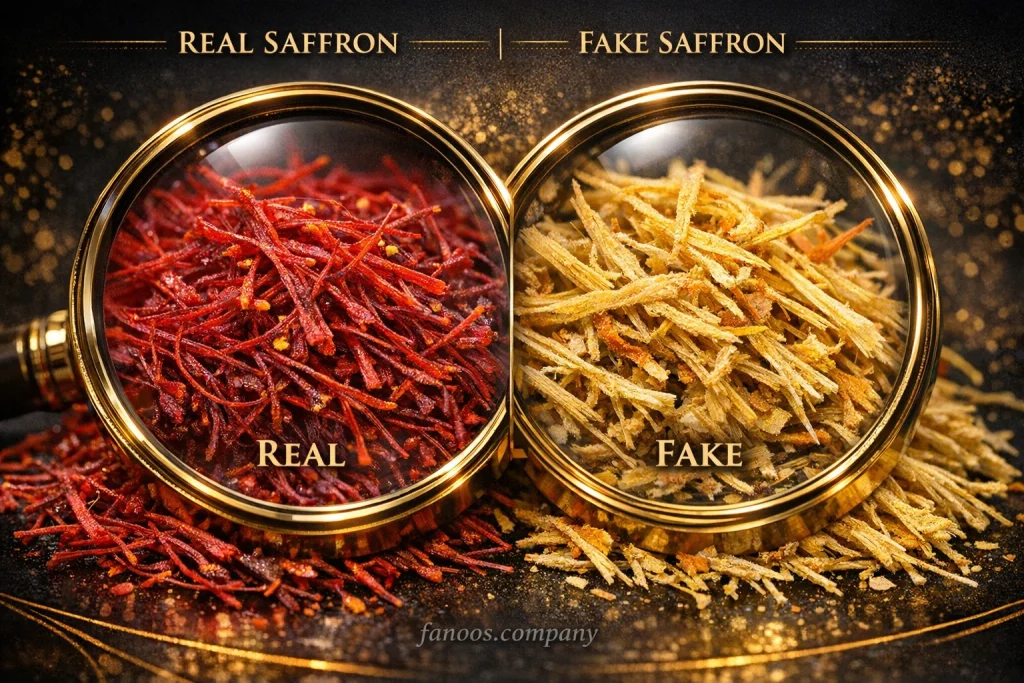
Why Saffron Adulteration Happens
Because saffron is expensive and labor‑intensive to produce, many sellers mix it with cheaper materials such as:
- Artificially colored corn silk
- Paprika threads or safflower petals
- Gelatin‑based synthetic fibers
- Dyed horsehair or plastic fibers
- Low‑grade saffron mixed with artificial color
Understanding saffron’s real physical and chemical characteristics is the key to identifying authentic product.
Part 1: Practical Home Methods to Identify Real Saffron
1. The Color Release Test (Warm Water Test)
Place a few saffron threads in warm water:
- Real saffron releases its color slowly over 5–10 minutes.
- Water becomes golden yellow or honey-colored.
- Threads maintain their shape and do not dissolve.
- The threads’ internal color remains red.
Fake saffron turns water red instantly and may lose its dye completely.
2. Crushing Test (Finger Rub Test)
Crush a thread between your fingers:
- Real saffron turns your fingers yellow.
- Fake saffron turns your fingers red or orange because of dye.
3. Smell Test
Real saffron has a unique aroma that blends:
- Warm hay-like notes
- Honey-like sweetness
- A slightly earthy tone
If the smell is artificial, too sweet, or perfume-like, it is likely fake.
4. Taste Test (Without Eating!)
Place a saffron thread on your tongue:
- Real saffron tastes slightly bitter.
- Fake saffron may be sweet or tasteless.
Important: Never swallow unknown saffron due to possible harmful dyes.
5. Thread Structure Examination
Authentic saffron threads are:
- Trumpet-shaped at one end
- Slightly curved
- Not uniform in shape or size
- Dark red, sometimes with very small yellow tips
Fake threads are often perfectly straight or unnaturally uniform.
6. Alcohol Solubility Test
Put saffron in alcohol:
- Real saffron releases color instantly in alcohol (because crocin is alcohol-soluble).
- Fake saffron may release dye unevenly or leave residue.
7. Paper Towel Absorption Test
Place a few threads on a wet paper towel:
- Real saffron slowly releases yellow, without spreading dye like ink.
- Fake saffron leaves a red stain quickly.
Part 2: Scientific and Laboratory Methods
1. ISO 3632 Quality Classification
The international saffron standard measures three key components:
- Crocin – coloring strength
- Picrocrocin – bitter taste
- Safranal – aroma intensity
Higher scores indicate premium saffron such as Super Negin.
2. UV-Visible Spectrophotometry
Genuine saffron shows specific absorption peaks at:
- 440 nm – crocin
- 330 nm – safranal
- 257 nm – picrocrocin
Fake or adulterated saffron displays irregular patterns.
3. Microscopy Analysis
Under a microscope, real saffron threads show:
- Grooved surface texture
- Natural tapering shape
- Red stigma tissues
Fake threads often appear smooth, uniformly colored, or synthetic.
4. Chemical Solubility Tests
Scientists evaluate saffron’s reaction with:
- Methanol – real saffron dissolves gradually
- Chloroform – real saffron does not dissolve
- Hydrochloric acid – no color separation in real saffron
Any unusual reaction may indicate adulteration.
5. Chromatography (HPLC)
High-performance liquid chromatography scientifically measures saffron’s active compounds, revealing:
- Purity level
- Presence of dyes
- Natural vs synthetic components
Part 3: Common Types of Fake Saffron
- Safflower petals (looks similar but gives weak color)
- Colored corn silk
- Dyed gelatin fibers
- Plastic threads
- Low-grade saffron mixed with dye
- Marigold or turmeric dyed as saffron powder
Part 4: How to Ensure You Always Buy Authentic Saffron
- Buy whole threads, not powder.
- Purchase from reputable sellers or certified brands.
- Look for ISO 3632 certification.
- Check packaging quality and sealed containers.
- Avoid unusually cheap products.
Conclusion
Distinguishing real saffron from fake requires understanding its natural color, aroma, structure, and chemical properties. By combining simple home tests—such as water testing, aroma evaluation, and thread inspection—with scientific methods like ISO 3632 classification and spectroscopy, you can confidently identify pure, authentic saffron. With the right knowledge, you can avoid fraud and enjoy the full value, aroma, and medicinal power of genuine saffron.